
Introduction
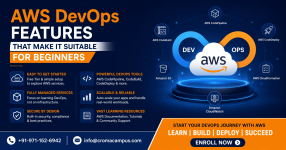
Amazon Web Services provides a better structure to the DevOps ecosystems. It combines infrastructure automation with managed services. Beginners benefit from predefined workflows and service integration. The AWS DevOps Course is designed for beginners and offers training in every industry-relevant topic. The platform reduces manual setup effort. Beginners can apply AWS DevOps concepts in real-time projects. This improves learning efficiency. AWS DevOps offers APIs and simple configuration options that make it easier for beginners to control and scale environments.1. Fully Managed CI/CD Services
AWS DevOps relies on managed services. These services speed up continuous integration and delivery in the systems. AWS CodePipeline handles Workflow stages. AWS CodeBuild streamlines compilation and testing processes. AWS CodeDeploy automates application rollout. These services remove infrastructure dependency. Beginners do not manage build servers. They only define pipeline stages. Each stage executes according to the events.- Git commits trigger Pipelines
- Containerized execution is used in Build environments
- Deployment improves with rolling and blue-green strategies
- Monitoring services and logs integrate for efficiency
- Failures automatically stop execution processes
2. Infrastructure as Code Using CloudFormation
AWS CloudFormation develops a declarative infrastructure within the systems. Formats like JSON or YAML enable developers to define resources effectively. AWS allocates resources accurately using templates. This feature is known as version-controlled infrastructure. Beginners learn reproducibility and consistency. They avoid manual configuration errors.Sample CloudFormation Syntax
Resources:
MyEC2Instance:
Type: AWS::EC2::Instance
Properties:
InstanceType: t2.micro
ImageId: ami-0abcdef12345
This syntax defines compute resources programmatically. It reflects DevOps automation principles.
3. Deep Integration With Source Control
AWS integrates seamlessly with Git-based repositories. Professionals get more control over the workflows with GitHub and AWS CodeCommit. This makes it easier for professionals to trace the systems. Every change trigger automation. This enables beginners to learn commit-based deployment patterns quickly.| Feature | Benefit for Beginners |
| Version Control | Tracking changes in codes accurately |
| Webhooks | Automating pipelines |
| Branching | Improves feature development |
| Rollback | Safer recovery |
Certificates like the AWS Certified DevOps Engineer certification enables aspiring professionals to land rewarding jobs.
4. Scalable Compute With Auto Scaling
Amazon EC2 provides scalable compute instances. AWS Auto Scaling adjusts capacity automatically. Auto scaling uses metrics like CPU usage. It adds or removes instances based on load. Beginners learn dynamic scaling without the need for manual provisioning.- Policies accurately define scaling thresholds
- Predefined templates help with instance launch
- Failed nodes are replaced by Health checks for efficiency
- Load balancers distribute the traffic evenly across systems
5. Monitoring and Observability
Amazon CloudWatch collects metrics and logs. It monitors system performance. Alarms get triggered according to thresholds. AWS DevOps offers features that make observation and analysis easier for beginners.| Component | Function |
| Metrics | Tracking CPU, memory, and latency |
| Logs | Storing application output |
| Alarms | Sending out alerts |
| Dashboards | Visualizing performance |
6. Identity and Access Management
AWS Identity and Access Management controls permissions. It uses policies and roles to restrict access. IAKM enables beginners to learn security fundamentals in AWS DevOps. They define least privilege access. This reduces risk exposure.- Allowed actions are defined under Policies
- Roles provide temporary access
- Users represent individuals in the system
- Groups make permission assignment simple
7. Containerization and Orchestration
Container workload is managed by tools like Amazon Elastic Container Service and Amazon Elastic Kubernetes Service. Containers isolate environments of the application. Beginners deploy microservices without dependency conflicts.- Professionals get simple orchestration with ECS
- EKS works well with Kubernetes-native workflows
- Containers use Docker images for efficiency
- Services can scale independently
8. Serverless Deployment Model
AWS Lambda executes code without servers. It runs functions based on events. Serverless architecture removes infrastructure management. Beginners can focus on logic instead of the servers.- API calls get triggered by Functions
- Execution time improves Billing
- Automatic scaling is enabled
DevOps adoption becomes easier with the above features. Operational overhead also reduces significantly.
9. Built-In Security and Compliance
AWS applies tight security across all services. The platform by default applies data encryption, logging, and compliance tools. AWS Key Management Service handles cryptographic keys. AWS CloudTrail records API activity. Security features help beginners follow best practices. They learn audit and compliance mechanisms early.- Encrypts data at rest and in transit
- Audits for all actions are logged
- Provides fine-grained access control
- Global standards compliance