
As we are moving towards the year 2026, Generative AI has changed a lot, and it is becoming an important part of how we work and live. We use this to write emails, design logos, as well as solve scientific puzzles. As these machines are getting smarter as well as human-like they have also raised concerns related to "what ifs" with them.
Well, Ethical AI is not just a topic for learning, but has become a necessity for anyone using a smartphone or running a business. In this article, we have discussed the ethical considerations of Generative AI in detail. Well, if you are looking to become an AI developer, then taking the Generative AI Course in Hyderabad can help in understand the Gen AI concepts easily. So let’s begin discussing the Ethical Considerations of Generative AI:
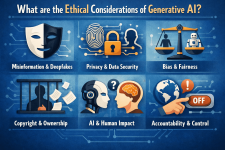
How Bias Manifests: When an AI generates an image of a "CEO," it might consistently show a middle-aged man. When it describes a "homemaker," it might default to a woman. This is called Representation Bias. If we aren't careful, AI doesn't just reflect our world; it amplifies our worst habits, making them seem like "objective" computer facts.
Seeking Fairness: To solve this, developers are working consistently on the Diverse Data Curation. This means intentionally feeding the AI a wider variety of perspectives. It’s also about "de-biasing" the models so they can recognize when they are being asked to produce something.
The Risk of Misinformation: In 2025, the risk isn't just a student getting a history date wrong. It’s about Deepfakes and synthetic news. AI can now create hyper-realistic videos of world leaders saying things they never said.
Data "Memory”: Ethically, we have to ask: Where does that data go? Some models "remember" what they are told to improve future answers. This creates a risk of Data Leakage, where your private information might accidentally show up in someone else's chat result.
The Right to an Explanation: If a bank uses an AI to decide who gets a loan and when this gets rejected, you may have an ethical right to know why. Explainable AI is the movement to make these systems more transparent.
Energy and Water: When this comes to training a single large model, this can consume more electricity than hundreds of homes use in a year. Also, these data centers need millions of gallons of water for cooling.
Job Evolution vs. Job Loss
While many argue that AI will create new jobs, the transition is complex. Ethically, companies have a responsibility to support Upskilling. We also have to be careful about giving AI a human personality. So people begin treating AI as a real friend or a therapist, as well as we risk losing the deep, complex, and essential human connections.
Thinking Gap: If a student uses AI to remind every book or a programmer uses this to write every line of the code, they might stop developing the great analytical skills that are needed to do these things manually. When we rely on AI for decision-making, we risk "blind trust”. This can lead to bad results if we stop double-checking the AI’s work with our own human judgment.
Well, Ethical AI is not just a topic for learning, but has become a necessity for anyone using a smartphone or running a business. In this article, we have discussed the ethical considerations of Generative AI in detail. Well, if you are looking to become an AI developer, then taking the Generative AI Course in Hyderabad can help in understand the Gen AI concepts easily. So let’s begin discussing the Ethical Considerations of Generative AI:
Ethical Considerations of Generative AI:
Here, we have discussed the Ethical Considerations of Generative AI in detail. So if you take the Gen Ai Course in Bangalore, then this may help you understand these considerations easilyBias and Fairness:
Generative AI learns from the vast amount of data gathered from books, articles, and social media posts. Well, the problem is that the internet is full of human history that includes prejudices.How Bias Manifests: When an AI generates an image of a "CEO," it might consistently show a middle-aged man. When it describes a "homemaker," it might default to a woman. This is called Representation Bias. If we aren't careful, AI doesn't just reflect our world; it amplifies our worst habits, making them seem like "objective" computer facts.
Seeking Fairness: To solve this, developers are working consistently on the Diverse Data Curation. This means intentionally feeding the AI a wider variety of perspectives. It’s also about "de-biasing" the models so they can recognize when they are being asked to produce something.
Truth vs. "Hallucinations:
One of the strange things about GenAI is its confidence. Well, this can tell you a complete lie with the same tone of authority. In the tech world, it is called hallucinations.The Risk of Misinformation: In 2025, the risk isn't just a student getting a history date wrong. It’s about Deepfakes and synthetic news. AI can now create hyper-realistic videos of world leaders saying things they never said.
3. Privacy in the Age of Synthesis:
When you chat with an AI, you might not be ready to share personal details. This may be a health concern or a sensitive work document that you want to be remembered.Data "Memory”: Ethically, we have to ask: Where does that data go? Some models "remember" what they are told to improve future answers. This creates a risk of Data Leakage, where your private information might accidentally show up in someone else's chat result.
4. Transparency:
Well, a major problem is that AI models are often confidential. Even with the people who build them, sometimes they don’t know exactly why the AI chose one word over another.The Right to an Explanation: If a bank uses an AI to decide who gets a loan and when this gets rejected, you may have an ethical right to know why. Explainable AI is the movement to make these systems more transparent.
5. The Environmental Cost:
We often think that AI that lives in huge data centers comes with thousands of power-hungry processors.Energy and Water: When this comes to training a single large model, this can consume more electricity than hundreds of homes use in a year. Also, these data centers need millions of gallons of water for cooling.
6. The Human Connection:
Finally, we have to look at the effect on people's lives. AI is incredibly good at tasks that used to require a college degree, which include writing, coding as well and legal research. Well, if you have to take a Generative AI Course in Noida, then this can help you understand these connections easily.Job Evolution vs. Job Loss
While many argue that AI will create new jobs, the transition is complex. Ethically, companies have a responsibility to support Upskilling. We also have to be careful about giving AI a human personality. So people begin treating AI as a real friend or a therapist, as well as we risk losing the deep, complex, and essential human connections.
7. Over-Reliance:
As Generative AI is becoming more capable, we are facing an ethical dilemma regarding our own independence. In 2025, we are seeing a growing trend of "Cognitive Offloading" where we allow AI to think for us as it is faster as well as easier.Thinking Gap: If a student uses AI to remind every book or a programmer uses this to write every line of the code, they might stop developing the great analytical skills that are needed to do these things manually. When we rely on AI for decision-making, we risk "blind trust”. This can lead to bad results if we stop double-checking the AI’s work with our own human judgment.
Conclusion:
As we are moving towards the year 2026, it is clear that Gen AI is no longer a futuristic concept which is a powerful tool used in daily lives. People who are looking to use AI need to learn to fulfill the responsibilities that come with this. Well, above mentioned points are not hurdles, but essential pillars or building a future where technology serves humanity.Attachments
-
 What are the ethical considerations of generative AI.png797.8 KB · Views: 0