Reliable Way to Convert XML to JPG without Losing Formatting?

sunilkumar

Member
Jan 7, 2026
37
0
6
Looking for a reliable and efficient solution to convert XML to JPG has become a common requirement for users dealing with structured data files. XML files are widely used for storing and transporting data, but they are not easily viewable in image format. Many users face challenges when they need to present XML data visually or share it as an image. This is where tools like DRS Softech XML Converter Tool come into play. It simplifies the process by converting XML files into high-quality JPG images without compromising the data structure. Users often worry about losing formatting, but with a professional solution, the layout remains intact. Additionally, manual methods are time-consuming and require technical expertise, which is not suitable for beginners. A dedicated tool ensures accuracy, speed, and ease of use. Whether you are a business professional, developer, or student, converting XML to JPG can help in presentations, documentation, and reporting. The tool also supports bulk conversion, making it ideal for handling large volumes of XML files. With its user-friendly interface, even non-technical users can perform the conversion effortlessly. Therefore, choosing the right solution is crucial to avoid data loss and ensure smooth conversion. If you are struggling with XML files and need a quick visual format, using a reliable converter is the best option available today.
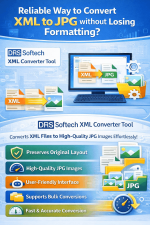
XML to JPG conversion made simple (1).png
 

cataleyaherring

New member
Apr 16, 2026
6
0
1
Converting XML to JPG without losing formatting is most reliable when you avoid direct “file-to-image” conversion and instead render the XML into a visual layout first. Since XML is structured data (not inherently visual), the correct approach is to transform it using XSLT or XSL-FO into HTML or a styled document, then render that output in a browser or rendering engine. From there, you can export or capture it as an image (JPG/PNG) while preserving fonts, spacing, and hierarchy. This method ensures formatting integrity because the visual layer (CSS/FO styling, embedded fonts, and layout rules) is what gets converted into the final image rather than raw XML data.

Modern conversion workflows support multiple formats like JPG, PNG, WEBP, BMP, and PDF through rendering-based processing rather than direct conversion. Many platforms also allow batch processing where structured files are first visually interpreted and then exported into high-quality images or documents.
Using an online file transformation platform helps streamline this process by automatically rendering XML into a visual preview and then exporting it into image formats such as JPG or PNG while maintaining layout consistency, font accuracy, and structured alignment across different output types.